Welcome

This website is now an archive of the restoration and should only be used as a resource. Please visit the Lion Salt Works website for the most up-to-date information.


Welcome to the Lion Salt Works blog

The Lion Salt Works is a historic brine salt making site that is being restored and transformed into a unique heritage attraction. Led by Cheshire West and Chester Council, this £8million project will see the site reborn as a fascinating destination for tourists, day visitors and families and a valued resource for local communities, businesses and heritage interest groups.

Located in the village of Marston, close to the town of Northwich, the site lies adjacent to the Trent and Mersey Canal and is close to the historic Anderton Boat Lift. A substantial part of the site is a Scheduled Monument.

Restoration work has now started on the site, with an expected opening in spring 2015. The Lion Salt Works is currently closed to the public.

Thursday, 16 May 2013

How to...Build a Pan House


The pan house was the area where the salt was produced in the open pan. They contained the stove and the ferrous metal pan.

Construction

The pan houses were predominantly made of wooden timber. The timber did not react to the salt steam and would not decompose. The timbers become impregnated with salt over time.

The side walls of the pan houses consisted of a low brick ‘sill’ wall with a wooden wall above of long vertical timbers clad in horizontal planks.

The fronts of the pans were originally open with a wooden cover over the stoves known as a ‘caboose’. This allowed an open-air area for the men to feed the stoves with coal. The pans were altered in the 1970s and are now closed in.

The roofs are now plain pitched roofs but originally had sloped hipped roofs. They were covered with corrugated asbestos, but originally they would have been felted. They were supported by wooden trusses. They were open at the apex to allow steam to escape from the pans below. The sides were covered to allow the workers some protection from the weather.


Pans


The pans were large ferrous metal structures c. 15m in length by c. 8m wide and the sides were about 0.5m high. They were made of a large number of smaller metal plates welded and riveted together. They stood on large brick stoves 2m high.

Brine was fed into the pans via a series of ferrous metal pipes. These ran from the brine tank underground and emerged in the pan houses. The pipes turned and then passed into the top of the pan. The pipes were fed by gravity, the brine tank was at a higher level than the pans. A series of taps allowed the control of the brine to different areas of the site.

When the boil was finished the excess brine would be drained from the corner of the pan via a hole known as the ‘Cotter Hole’. The brine drained directly into the ditches that ran down the side of the stove (see below).

Along the front of the pan were several metal brackets and a series of planks known as dodging planks designed to allow access to clean the pan.

Along the side of the pan were a series of metal racks known as ‘salt dogs’ designed to hold the tubs as they were filled. This allowed the brine to drain back into the pan.


Stoves

The stoves were built of brick and fueled by coal and later oil. The coal was fed into the front of the pan via hatches by hand. See Pan House 3.

The stoves were originally fueled by coal (See Pan House 3). Coal was fed into the stove via small metal hatches. The fires were set at the front of the stove on metal grates.


Coal

Coal was brought to the site by small wagons on an individual train track. These tracks ran along the front of the pans and allowed coal to be stored adjacent to the stoves (see transport). Coal was stored behind the wooden barricades, a series of horizontal planks set on side.

Oil and the Oil Tank

In the 1970s the stoves were converted to oil. The oil was stored in the large oil tank adjacent to Pan House 4. The oil was fed into the pans via a compressor in the lean-to structure. The oil was fed into the pans by rubberised pipes and valves set in the front of the stoves. This was lit and hot jets of burning oil fired the pans.


The Hurdles

Down either side of the pan was a wooden walkway called the ‘hurdles’. It was from here the lumpmen drew the salt from the boiling pan. This was done with a large skimmer. The salt was skimmed and turned into the salt tubs, before drying on the pan and being turned out on the hurdle walkway. As the pillars of salt dried, excess brine drained through the wooden hurdles to the brick lined ditch below. These can be seen along the side of Pan House 3.
The hurdles led directly into the stove houses via two doorways. The blocks would be wheeled into the stove houses on salt barrows.

How to....extract brine from the ground


Salt has been produced in the Cheshire Area for over 2000 years. This was a as a result of Cheshire’s unusual geology which resulted in the formation of large salt deposits located beneath the ground.

Geology

The Cheshire Basin between the hills of the Delamere Forest and the Staffordshire and Derbyshire border once formed a large basin fed by the sea to the north. As the land levels to the north rose, this area was cut off from the sea but was occasionally inundated with sea water at high tides forming a large salt lake. Sedimentation and evaporation led to deposits of salt forming between layers of soft sedimentary rock known as marlstone.

The Cheshire salt-beds lie in the red or Triassic Keuper marls in a kind of basin comparable with an elongated saucer with its longest axis lying in a nearly north and south direction. The best-known and most important beds of rock salt are about the centre of this basin, in the neighbourhoods of Northwich and Winsford located below what is now the level of the sea.

Two beds of rock salt exist in Northwich an upper and lower bed. These beds spread from the Northwich town centre in the Baron Quay’s area to the north-east of Marston in an area around two miles in diameter. Each bed is from 25.6 to 27.4m (84 to 90 feet) in thickness at Marston and Wincham, divided from each other by 9 to 10m (30 to 33 feet) of marl and marlstone. For example salt was located at Neumann’s Mine between 60 feet and 144 feet below Ordnance Datum in the upper bed and 174 feet and 258 feet in the lower bed. The bottom part of the lower bed was found uniformly to be the best quality.

Brine Springs

The surface of the upper bed was impermeable and an underground stream of water would flow across it. Where this stream of water came close to the ground surface, at locations on the side of the Weaver or Wheelock valleys the water would emerge as a brine spring. The springs would look like most other springs, a small pool of water bubbling from the ground within shallow valley locations. The difference was within the water itself which would have been saline.

These became the first locations for salt making in the Prehistoric and Roman periods. Brine springs denote the locations of the Cheshire Salt towns of Northwich, Winsford, Middlewich and Nantwich.

Salt Mining

In the 17th century the first of a series of mines were begun in the Northwich region. A bed of rock salt was discovered in 1670 by the Smith-Barry family when they were searching for coal on the Marbury Estate, near Marston. This is believed to be the first mine sunk for rock salt into the upper bed of salt at around 50 feet below the surface. This resulted in the excavation of a number of ‘top rock’ mines around Northwich. The early top rock mines resulted in subsidence in the area.

By 1779 investigation below the upper bed of rock salt resulted in the discovery at the Marston Mine of a lower bed of salt at a depth of around 150 feet. This was also mined for a number of years until it began to be exhausted around 1850. During the 19th century the mines of the Northwich district began to collapse and subsidence was widespread.

Wild Brine Extraction

Wild brine extraction or brine ‘tapping’ had been carried on since the 17th century. This involved the sinking of a shaft to natural brine streams below the ground that ran over the upper bed of salt. This was then extracted and used to make salt by the open pan salt process.

The exhaustion of the mined rock salt supplies resulted in a rapid expansion of the wild brine extraction techniques. This was aided by more efficient pumps that allowed the brine to be pumped from both the upper and lower beds. The process of brine-tapping involved the sinking of a shaft to the brine stream, a dangerous occupation. AK Calvert describes the process;

In sinking to many of the springs, the supply of brine, when cut into, was so copious that the sinkers had to flee for their lives, ascending the shaft among the brine, and having no opportunity of seeing what was underneath.

The brine was subsequently pumped out of the ground to supply the salt works based at the surface. By the late-19th century brine shafts and traditional open pan salt works dominated the area around Northwich many controlled by the monopolistic Salt Union.

As the rock salt mines closed they were inundated with water creating vast underground reservoirs of brine. These were increasingly tapped for brine and it became increasingly common to deliberately flood the mines to provide new sources of brine. The erosion of the sides of the mine by the brine streams led to more and more mines collapsing and subsidence was widespread in the Northwich area. This can be seen by the large flashes that dominate the salt-making landscape.

Monday, 3 December 2012

November 2012 - Repairing the Stove Houses and Treating the Brine Shaft


The early winter mornings sees red sunrises to the east over the Lostock Gralam Chemical Works.


The repair of the stove house walls
The walls of the stove houses are very narrow, normally two bricks thick. They are fragile where the salt has damaged and removed the mortar. In places, the Thompson’s put rigid steel joists into the wall to reinforce them.


Not all the walls will be dismantled during the restoration. Instead small parts will be taken down, repaired and rebuilt brick by brick.


Elsewhere the walls have bulged with the weight of ash and cinder retained behind them in the stove houses. The ash and cinder was used to build up the level of the flues internally to the stove house.

Fixing Spiro-ties

These walls are retained using spiro-ties; strips of spiral metal designed to strengthen the individual courses of the brick-work. Buttresses will be built to strengthen the wall.


Clearing the collapsed tunnel
The collapsed tunnel
Between the Link Block and the Packing Area were the collapsed remains of a tunnel. This originally ran from the canal to the Red Lion Hotel and dates to the earliest period of the Thompson’s ownership of the site in the 1890s.


An interesting find
At some point the tunnel was covered over with metal sheets. These had decayed and the remains collapsed into the tunnels. This had to be cleared in order to allow safe access to the area around the base of the chimney in the packing area.


Treating the brine shaft
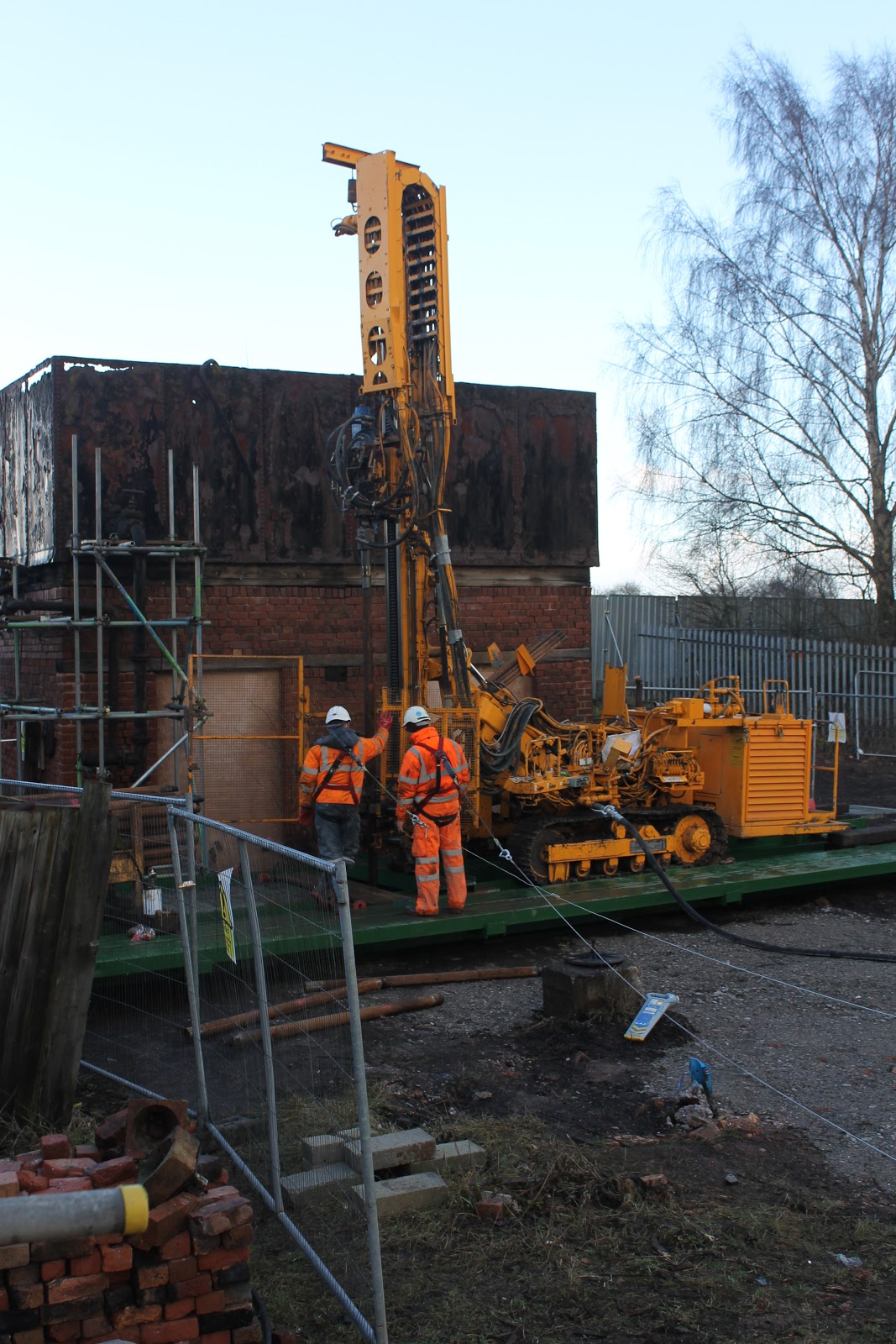
The former brine shaft originally dug in 1894 must be treated in order to prevent water infiltrating the layers of salt below the ground. The area around the brine shaft has been cleared to allow the large drilling rig to be brought in. This involves clearing the old oil tank bases built in the 1970s.

Clearing the 1970s oil tank


Fallen brine pipes were removed to storage before being placed back once work was finished.


The drilling rig sits on two large rigid steel joists.

Laying out the support for the drilling rig
 The process involves drilling down to the salt layer 45m below. 

Drilling the brine shaft


A mixture of salt water, cement and ash is pumped into the drilled hole and this hardens and seals the brine shaft preventing further water infiltration.


European Visitors – Manage +

At the end of the month one of our key partners in the project visited site.


Funding from the manage+ project gives the Lion Salt Works a european dimension. Manage+ http://www.manageplus.eu/en/manageplus/about-manage.html aims to develop and implement innovative, sustainable and cost-effective models for the management and operation of regenerated areas. Manage+ includes five pilot sites formerly used for industry or military purposes in four European countries (UK, Belgium, Netherlands and Germany) which are being converted into business parks, greenbelt recreation areas and tourist destinations. The 10th partner meeting was held in Chester from 28th to 30th November with delegates from all partner countries taking part in workshops and site visits.

Friday, 9 November 2012

A History of the Lion Salt Works


In a new part of the Lion Salt Works blogs we will look at the history, processes and people of the Lion Salt Works and salt industry in Cheshire in our in depth history guides. This will bring together historical reports and the latest research where possible. The blogs will also try to explain the different buildings and processes at the Lion Salt Works in the easy …How to … guides.

Rock salt was first exploited in Marston in 1781, when John Gilbert the elder, notable engineer and factor to the Duke of Bridgewater, purchased the Symme Fields for £2,000. He developed the Marston Mine, to the west of the later Lion Salt Works site, by sinking a 300ft deep shaft, and installing a Boulton and Watt engine to wind rock salt and pump brine. In 1821 John Gilbert the younger sold the Symme Fields to John Buckley, tenant farmer at Marston Hall Farm.

In 1856 John Thompson Senior (1790-1867) and John Thompson Junior (1821-1899) obtained from John Buckley a 50 year lease for the Outlet Field (part of Symme Fields), where they constructed the Alliance Salt Works. This was served by a canal arm linked to the Trent and Mersey Canal, and a siding on the Marston Branch of the Cheshire Midland Railway. In 1874 Jabez Thompson was in possession of the works. In 1877 a number of houses were constructed on Ollershaw Lane, probably to accommodate workers at the Lion Salt Works. These included the current buildings of the Red Lion Inn. In 1888, the Thompson family sold the Alliance Salt Works to the Salt Union. The Alliance Salt Works closed around 1900 and the site passed from the Salt Union into the ownership of Imperial Chemical Industries (ICI), who retained the salt rights.

The Lion Salt Works in 1898 (Ordnance Survey)
In 1894, following disagreement with the Salt Union over the roles of Thompson family members, John Junior and his son, Henry Ingram Thompson, constructed a new salt works in the coal yard of the Red Lion Hotel, and the works became known as the ‘Lion Salt Works’. Initially the Lion Salt works adopted the buildings of the Red Lion Hotel. The new company quickly built a series of pan and stove houses between the hotel and the canal, that include Pan 2, Stove House 2, the Link Building and a former building in the Pan House Garden (Pan 1). A brine shaft was sunk in the yard of the hotel and a brine tank was built that still stands today.

The Lion Salt Works in 1910 (Ordnance Survey)
When John Thompson Junior died in 1899, Henry Ingram Thompson took over the salt business, and an inventory of the salt works was created in that year, valuing the Lion Salt Works at £6,600. The inventory included a new pan and stove house (Pan and Stove House 3), as well as a number of common pans that have now been demolished. The small single-storey ‘manager’s office’ was built separate to the site. In 1901 Henry Ingram Thompson erected a new salt store by the canal on the west side of Ollershaw Lane, this became known as the ‘Coronation Warehouse’.

It was about this time that two former cottages along Ollershaw Lane were extended to the rear and turned into the Red Lion Inn, a direct replacement of the former Red Lion Hotel.

The Lion Salt Work in the 1910s,
note the curved roof of the Coronation Salt Store
In the 1950s the common pans described above were demolished and replaced by Pan and Stove House 4. The old brine shaft was abandoned and filled with cinders. A new shaft was built and served by a reclaimed steam engine and a nodding-donkey pump, still visible on site today.

Pan House 3 from Ollershaw Lane in the 1960s,
note the old style  of hipped roof
and the  now dismantled chimney
In the early 1960s, Alan Thompson and Henry Lloyd Thompson purchased land from ICI, on the Alliance Works site, in order to erect Pan House 5, which received planning consent in 1965. At about the same time, a new borehole was drilled to the east of the original brine shaft, and an electrical submersible pump installed. The existing engine house was rebuilt in c.1980; and Pan No.1 became unsafe during the early 1980s, and was therefore demolished.

In June 1986, the outbreak of the Nigerian civil war precipitated the closure of the works, as the main market was located in West Africa, and the site was purchased by Vale Royal Borough Council. The Red Lion Inn was leased to Macclesfield and Vale Royal Groundwork Trust, and converted to offices and exhibition space. The lease to the whole site was transferred to the Lion Salt Works Trust.

The Salt Wagons served the site via a separate branch line


October 2012 - Rebuilding the Pan Houses

The pump house chimney turned red by an October sunset
As October passes the nights are drawing in. The early morning mist clings to the site to midday and the evening skies bleach the buildings red.


Rebuilding Pan House 4 Walls
The short wall along Pan House 4 is dismantled
With the scaffold complete, preparation starts to rebuild the walls of the individual buildings. Some walls have to be entirely taken down brick by brick. A foundation of concrete is laid and the wall built back up using the original bricks.
The collapsed wall of Pan House 4
One of the major tasks over the next month will be to take down the walls between Pan House 3 and Stove House 3; and the identical wall between Pan House 4 and Stove House 4. In order to rebuild it strong foundations were needed and the area was dug out through a mix of brick rubble and concrete to foundation level. The material was so strong breakers were needed to remove it.


The metal plate that carried up the wall:
note the decay caused by the salt
These walls between the pan and stove houses were both structurally weak. The culprit: large metal plates that allowed the flues to pass under the walls. They had become infiltrated with salt and decayed. The wall of Pan House 4 was in such bad repair it had partially collapsed.

 The excavation revealed for the first time in fifty years the remains of the flues that came out from the rear of the pans.
The area at the back (northern) side of Pan 4 revealed
for the first time in 50 years; four flues pass to Stove House 4

Clearing Pan 2
Around Pan 2, were the collapsed remains of the former pan house. These timbers have been carefully recorded and removed in order to make the area safe. 


On the north side of Pan 2: dense undergrowth had
hidden the broken skeleton of the former Pan House
Pan and Stove House 3
Other areas are built of timber and the planks. In Stove House 3 these are being removed in order to dismantle the wall prior to rebuilding it brick by brick in the same location. The timbers are being removed, propped and the rotten material replaced.
The gable end of Stove House 3 is propped  prior to taking the central wall down.
It has not just been a destructive process; the first walls of Pan House 3 have been rebuilt, brick by brick; the mortar carefully selected to match the subtle hues of the various mixes of mortar used on site.

A momentous moment: the first wall is rebuilt on site - so begins restoration