Welcome

This website is now an archive of the restoration and should only be used as a resource. Please visit the Lion Salt Works website for the most up-to-date information.


Welcome to the Lion Salt Works blog

The Lion Salt Works is a historic brine salt making site that is being restored and transformed into a unique heritage attraction. Led by Cheshire West and Chester Council, this £8million project will see the site reborn as a fascinating destination for tourists, day visitors and families and a valued resource for local communities, businesses and heritage interest groups.

Located in the village of Marston, close to the town of Northwich, the site lies adjacent to the Trent and Mersey Canal and is close to the historic Anderton Boat Lift. A substantial part of the site is a Scheduled Monument.

Restoration work has now started on the site, with an expected opening in spring 2015. The Lion Salt Works is currently closed to the public.

Monday, 3 December 2012

November 2012 - Repairing the Stove Houses and Treating the Brine Shaft


The early winter mornings sees red sunrises to the east over the Lostock Gralam Chemical Works.


The repair of the stove house walls
The walls of the stove houses are very narrow, normally two bricks thick. They are fragile where the salt has damaged and removed the mortar. In places, the Thompson’s put rigid steel joists into the wall to reinforce them.


Not all the walls will be dismantled during the restoration. Instead small parts will be taken down, repaired and rebuilt brick by brick.


Elsewhere the walls have bulged with the weight of ash and cinder retained behind them in the stove houses. The ash and cinder was used to build up the level of the flues internally to the stove house.

Fixing Spiro-ties

These walls are retained using spiro-ties; strips of spiral metal designed to strengthen the individual courses of the brick-work. Buttresses will be built to strengthen the wall.


Clearing the collapsed tunnel
The collapsed tunnel
Between the Link Block and the Packing Area were the collapsed remains of a tunnel. This originally ran from the canal to the Red Lion Hotel and dates to the earliest period of the Thompson’s ownership of the site in the 1890s.


An interesting find
At some point the tunnel was covered over with metal sheets. These had decayed and the remains collapsed into the tunnels. This had to be cleared in order to allow safe access to the area around the base of the chimney in the packing area.


Treating the brine shaft
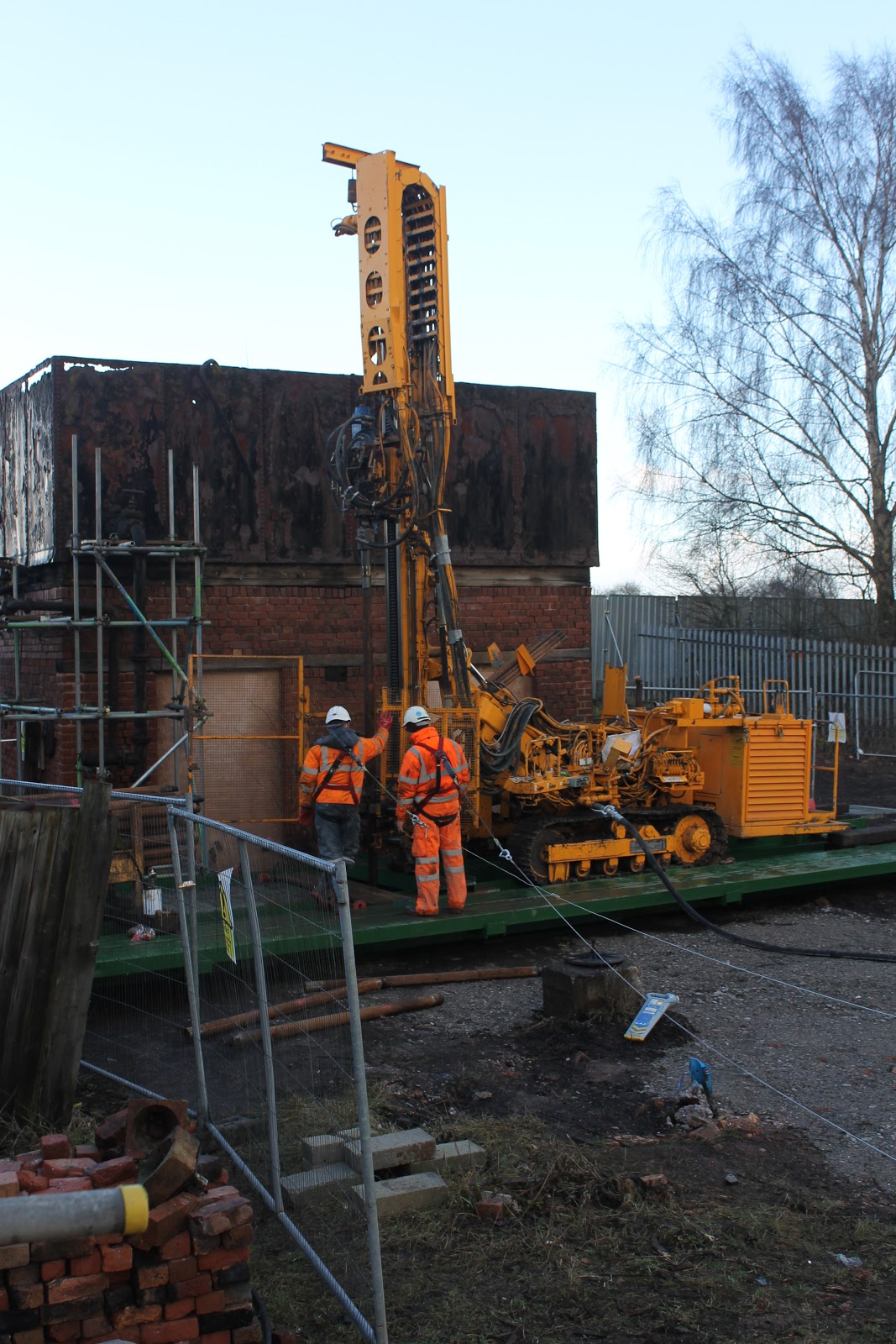
The former brine shaft originally dug in 1894 must be treated in order to prevent water infiltrating the layers of salt below the ground. The area around the brine shaft has been cleared to allow the large drilling rig to be brought in. This involves clearing the old oil tank bases built in the 1970s.

Clearing the 1970s oil tank


Fallen brine pipes were removed to storage before being placed back once work was finished.


The drilling rig sits on two large rigid steel joists.

Laying out the support for the drilling rig
 The process involves drilling down to the salt layer 45m below. 

Drilling the brine shaft


A mixture of salt water, cement and ash is pumped into the drilled hole and this hardens and seals the brine shaft preventing further water infiltration.


European Visitors – Manage +

At the end of the month one of our key partners in the project visited site.


Funding from the manage+ project gives the Lion Salt Works a european dimension. Manage+ http://www.manageplus.eu/en/manageplus/about-manage.html aims to develop and implement innovative, sustainable and cost-effective models for the management and operation of regenerated areas. Manage+ includes five pilot sites formerly used for industry or military purposes in four European countries (UK, Belgium, Netherlands and Germany) which are being converted into business parks, greenbelt recreation areas and tourist destinations. The 10th partner meeting was held in Chester from 28th to 30th November with delegates from all partner countries taking part in workshops and site visits.

Friday, 9 November 2012

A History of the Lion Salt Works


In a new part of the Lion Salt Works blogs we will look at the history, processes and people of the Lion Salt Works and salt industry in Cheshire in our in depth history guides. This will bring together historical reports and the latest research where possible. The blogs will also try to explain the different buildings and processes at the Lion Salt Works in the easy …How to … guides.

Rock salt was first exploited in Marston in 1781, when John Gilbert the elder, notable engineer and factor to the Duke of Bridgewater, purchased the Symme Fields for £2,000. He developed the Marston Mine, to the west of the later Lion Salt Works site, by sinking a 300ft deep shaft, and installing a Boulton and Watt engine to wind rock salt and pump brine. In 1821 John Gilbert the younger sold the Symme Fields to John Buckley, tenant farmer at Marston Hall Farm.

In 1856 John Thompson Senior (1790-1867) and John Thompson Junior (1821-1899) obtained from John Buckley a 50 year lease for the Outlet Field (part of Symme Fields), where they constructed the Alliance Salt Works. This was served by a canal arm linked to the Trent and Mersey Canal, and a siding on the Marston Branch of the Cheshire Midland Railway. In 1874 Jabez Thompson was in possession of the works. In 1877 a number of houses were constructed on Ollershaw Lane, probably to accommodate workers at the Lion Salt Works. These included the current buildings of the Red Lion Inn. In 1888, the Thompson family sold the Alliance Salt Works to the Salt Union. The Alliance Salt Works closed around 1900 and the site passed from the Salt Union into the ownership of Imperial Chemical Industries (ICI), who retained the salt rights.

The Lion Salt Works in 1898 (Ordnance Survey)
In 1894, following disagreement with the Salt Union over the roles of Thompson family members, John Junior and his son, Henry Ingram Thompson, constructed a new salt works in the coal yard of the Red Lion Hotel, and the works became known as the ‘Lion Salt Works’. Initially the Lion Salt works adopted the buildings of the Red Lion Hotel. The new company quickly built a series of pan and stove houses between the hotel and the canal, that include Pan 2, Stove House 2, the Link Building and a former building in the Pan House Garden (Pan 1). A brine shaft was sunk in the yard of the hotel and a brine tank was built that still stands today.

The Lion Salt Works in 1910 (Ordnance Survey)
When John Thompson Junior died in 1899, Henry Ingram Thompson took over the salt business, and an inventory of the salt works was created in that year, valuing the Lion Salt Works at £6,600. The inventory included a new pan and stove house (Pan and Stove House 3), as well as a number of common pans that have now been demolished. The small single-storey ‘manager’s office’ was built separate to the site. In 1901 Henry Ingram Thompson erected a new salt store by the canal on the west side of Ollershaw Lane, this became known as the ‘Coronation Warehouse’.

It was about this time that two former cottages along Ollershaw Lane were extended to the rear and turned into the Red Lion Inn, a direct replacement of the former Red Lion Hotel.

The Lion Salt Work in the 1910s,
note the curved roof of the Coronation Salt Store
In the 1950s the common pans described above were demolished and replaced by Pan and Stove House 4. The old brine shaft was abandoned and filled with cinders. A new shaft was built and served by a reclaimed steam engine and a nodding-donkey pump, still visible on site today.

Pan House 3 from Ollershaw Lane in the 1960s,
note the old style  of hipped roof
and the  now dismantled chimney
In the early 1960s, Alan Thompson and Henry Lloyd Thompson purchased land from ICI, on the Alliance Works site, in order to erect Pan House 5, which received planning consent in 1965. At about the same time, a new borehole was drilled to the east of the original brine shaft, and an electrical submersible pump installed. The existing engine house was rebuilt in c.1980; and Pan No.1 became unsafe during the early 1980s, and was therefore demolished.

In June 1986, the outbreak of the Nigerian civil war precipitated the closure of the works, as the main market was located in West Africa, and the site was purchased by Vale Royal Borough Council. The Red Lion Inn was leased to Macclesfield and Vale Royal Groundwork Trust, and converted to offices and exhibition space. The lease to the whole site was transferred to the Lion Salt Works Trust.

The Salt Wagons served the site via a separate branch line


October 2012 - Rebuilding the Pan Houses

The pump house chimney turned red by an October sunset
As October passes the nights are drawing in. The early morning mist clings to the site to midday and the evening skies bleach the buildings red.


Rebuilding Pan House 4 Walls
The short wall along Pan House 4 is dismantled
With the scaffold complete, preparation starts to rebuild the walls of the individual buildings. Some walls have to be entirely taken down brick by brick. A foundation of concrete is laid and the wall built back up using the original bricks.
The collapsed wall of Pan House 4
One of the major tasks over the next month will be to take down the walls between Pan House 3 and Stove House 3; and the identical wall between Pan House 4 and Stove House 4. In order to rebuild it strong foundations were needed and the area was dug out through a mix of brick rubble and concrete to foundation level. The material was so strong breakers were needed to remove it.


The metal plate that carried up the wall:
note the decay caused by the salt
These walls between the pan and stove houses were both structurally weak. The culprit: large metal plates that allowed the flues to pass under the walls. They had become infiltrated with salt and decayed. The wall of Pan House 4 was in such bad repair it had partially collapsed.

 The excavation revealed for the first time in fifty years the remains of the flues that came out from the rear of the pans.
The area at the back (northern) side of Pan 4 revealed
for the first time in 50 years; four flues pass to Stove House 4

Clearing Pan 2
Around Pan 2, were the collapsed remains of the former pan house. These timbers have been carefully recorded and removed in order to make the area safe. 


On the north side of Pan 2: dense undergrowth had
hidden the broken skeleton of the former Pan House
Pan and Stove House 3
Other areas are built of timber and the planks. In Stove House 3 these are being removed in order to dismantle the wall prior to rebuilding it brick by brick in the same location. The timbers are being removed, propped and the rotten material replaced.
The gable end of Stove House 3 is propped  prior to taking the central wall down.
It has not just been a destructive process; the first walls of Pan House 3 have been rebuilt, brick by brick; the mortar carefully selected to match the subtle hues of the various mixes of mortar used on site.

A momentous moment: the first wall is rebuilt on site - so begins restoration

Sunday, 21 October 2012

September 2012 - Completing the Scaffold


The scaffold is complete…

Completing the scaffold over the summer months was a long and difficult process given the condition of the buildings. Seven buildings in total within the historic core had to be propped: both Pan Houses 3 and 4, Stove Houses 2, 3 and 4, the Link Block and the Packing Area.

The scaffold of each historic building had to be individually designed in order to take the unique weights and stresses. The scaffold secures the walls and floors and takes the weight from existing structure of cast iron columns, iron girders, wooden posts and beams. The scaffold not only props the building but allows access to the upper working areas of the site: the roofs, the roof beams and the upper floors. Without the scaffold the working environment would be too dangerous.

With the scaffold in place the future of the building is secure and many of the initial restoration tasks can now be undertaken.


Meet the team

The enabling work that stabilised the building was undertaken by Wates Construction and they have now been contracted to undertake the main restoration work. They will be ably assisted by William Anelay who undertook the enabling works in 2009 that saw the dismantling of many of the partially collapsed structures.


The restoration process

In order to secure the structural condition of the buildings the internal and walls of the building will be entirely rebuilt. In places these had partly collapsed as they had been built on metal plates and girders that had disintegrated due to the corrosive effects of salt reacting with the metal.

In addition external walls will be dismantled and rebuilt on more secure foundations.

This will involve brick by brick dismantling of the wall and excavation down to foundation level before rebuilding.

Grouting the Brine Shaft and Boreholes

The former brine shaft that allowed brine to be extracted from the brine streams flowing beneath the site has to be grouted in order to make it safe. Although the location of the brine shaft was known from historic maps and plans it was necessary to locate it on the ground.

The Heritage Open Day 2012


As part of Cheshire’s Heritage Open Days 2012 the Lion Salt Works was one of a number of sites open across the region on the weekend of the 9th, 10th and 11th of September.

Visitors were shown round the site and given talks by Chris Hewitson, the Project Archaeologist and Bernhard Talbot, the site manager for Wates Construction.

Visitors were able to walk around the site and a museum display was located in the ground floor of the Red Lion Inn.

The open day was an opportunity for people to visit the site but also for people to come and share their memories of the works. We had visitors who had worked on the site, who remembered the site when they were children and those who had lived in the local area including the Salt Barge pub across the street. We hope to capture these memories as part of the Salt Memories – Oral History Project.